
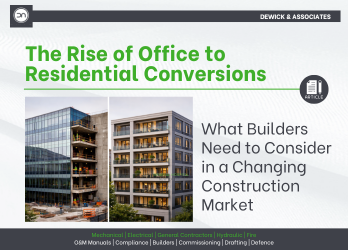
The Rise of Office to Residential Conversions: What Builders Need to Consider in a Changing Construction Market
Office-to-residential conversions have rapidly become one of the most discussed sectors within the construction and property industries as developers, asset owners and governments respond to changing workplace trends, housing shortages and increasing sustainability targets.
The shift towards hybrid working following COVID 19 fundamentally altered office utilisation patterns globally. Increased vacancy rates, changing workplace requirements and reduced demand for ageing commercial buildings have created opportunities for adaptive reuse projects that re-purpose underutilised office assets into residential developments.
In the United Kingdom, office-to-residential conversions have become a major component of housing delivery. Since permitted development reforms were introduced, government data shows that almost 96,000 homes have been created through office conversions¹ with over 5,150 new dwellings delivered through office-to-residential permitted development pathways during 2024–25 alone.² As housing supply pressures continue and office demand remains subdued in many locations, adaptive reuse continues to form an important part of the UK development pipeline.
Australia is experiencing similar market pressures, with elevated office vacancy rates continuing across major cities alongside ongoing housing supply challenges. According to the latest national office market data, Australia’s overall office vacancy rate increased to 15.9% in January 2026, representing the highest levels seen in decades, while CBD vacancy rates reached 14.8% nationally.³ Cities such as Melbourne continue to experience particularly elevated vacancy, with office vacancy reaching approximately 19%³, increasing pressure to explore alternative uses for ageing commercial stock. Combined with continued housing supply constraints and population growth, these market conditions are increasing interest in adaptive reuse and office-to-residential conversion opportunities across Australian cities.
Canada is increasingly positioning office-to-residential conversion as both a housing supply solution and an asset repositioning strategy. Recent office market reporting shows that conversion activity accelerated throughout 2025, with over 2 million square feet of office space removed from inventory for conversion during the second half of 2025 alone. Since 2021, approximately 7.8 million square feet of former office space has been removed from inventory through conversion projects 4 , with residential developments representing the dominant reuse pathway. Calgary continues to lead Canadian markets in adaptive reuse activity, accounting for almost half of all converted office space and demonstrating how ageing commercial assets are increasingly being re-positioned into residential and mixed-use developments.
While these projects present significant opportunities, office-to-residential conversions introduce technical, regulatory and construction challenges that differ substantially from traditional residential developments.
For builders, successful conversion projects require far more than simply changing internal layouts. They require careful consideration of building constraints, compliance obligations, building services infrastructure and long-term operational performance.
Sustainability Is Driving Adaptive Reuse
One of the strongest drivers behind office conversion projects is sustainability.
Demolishing existing buildings and constructing new developments generates significant embodied carbon through demolition activities, waste generation, material production and transportation. Retaining existing structures allows substantial portions of this embodied carbon to remain within the built environment while reducing overall construction waste and material consumption. This has become increasingly important as developers, investors and governments pursue net-zero objectives and lower-carbon construction strategies.
Research into adaptive reuse projects has consistently demonstrated that retaining existing structures can significantly reduce overall carbon impacts when compared with complete demolition and rebuild approaches. Recent modelling of office conversion opportunities within Melbourne suggested large-scale adaptive reuse strategies could substantially reduce energy consumption and annual carbon emissions while simultaneously increasing housing supply.
For many developers, office conversions are no longer simply property decisions, they are increasingly sustainability and ESG decisions.
Not Every Office Building Can Be Successfully Converted
One of the most common misconceptions surrounding office conversion projects is that vacant office buildings automatically create viable residential developments. Commercial office buildings were originally designed around completely different operational requirements. Large floorplates, central building cores, deep leasing spaces and commercial occupancy arrangements can create substantial limitations when attempting to create compliant residential apartments. Residential developments require:
- Access to natural light
- Adequate natural ventilation
- Practical apartment depths
- Appropriate building services distribution
- Residential fire safety arrangements
- Acoustic separation
- Efficient circulation and egress
Deep floorplates remain one of the largest barriers to successful conversions, as apartments located too far from façades may struggle to achieve acceptable daylight access and ventilation performance. Builders who thoroughly assess existing building constraints early are significantly better positioned to reduce redesign risk and improve project certainty.
Building Services Usually Become the Largest Technical Challenge
Although structural modifications often receive significant attention during early project planning, building services infrastructure frequently becomes the largest technical constraint within office-to-residential conversions. Commercial buildings were never originally designed to support hundreds of individual kitchens, bathrooms, apartment ventilation systems and residential utility services.
Mechanical systems commonly require extensive modification to accommodate residential ventilation requirements, kitchen exhaust systems, bathroom exhaust systems, smoke control interfaces and apartment-level temperature control strategies.
Similarly, hydraulic systems must transition from relatively simple commercial arrangements to significantly more complex residential layouts involving additional drainage stacks, increased sanitary loading, apartment metering and hot water distribution systems.
Electrical infrastructure often requires substantial redesign to support residential metering arrangements, revised distribution systems, communications infrastructure and increasing EV charging requirements.
Industry experience consistently demonstrates that mechanical, electrical, fire and hydraulic (MEP) modifications frequently become one of the largest programme and cost risks associated with conversion projects.
Builders who coordinate services design early generally reduce construction conflicts, minimise rework and improve installation efficiency.
Fire Safety and Compliance Requirements Continue to Increase
Fire safety remains one of the most important considerations within office conversion projects. Changing building classifications often triggers substantial regulatory implications and may require significant modifications to fire protection systems, compartmentation strategies and life safety systems. This has become increasingly important following greater scrutiny of residential building safety after major fire events, increasing regulatory oversight and evolving performance expectations. Builders should expect significant review of:
- Fire compartmentation
- Means of escape
- Smoke hazard management
- Building services interfaces
- Façade performance
- Fire stopping and penetration management
- Structural fire protection
Many fire-related upgrades become difficult and expensive once construction has commenced, making early coordination between builders, consultants and approval authorities essential.
Beyond physical fire safety measures, post-Grenfell regulatory changes in the UK have also increased focus on building information management and lifecycle documentation. The introduction of concepts such as the Golden Thread of Information has reinforced the importance of maintaining accurate, accessible and coordinated building information throughout design, construction, handover and occupation.
For office-to-residential conversions, where retained structures frequently interact with new systems and modified fire strategies, maintaining structured documentation becomes increasingly important. Builders must increasingly consider not only how buildings are constructed, but also how compliance evidence, asset information, commissioning records and operational documentation are captured and transferred throughout the project lifecycle.
Energy Performance Expectations Are Increasing
Energy performance has become a critical driver in office-to-residential conversion projects, influencing feasibility, compliance outcomes and long-term asset value.
Many older office buildings were not designed to meet modern residential energy efficiency expectations and therefore require substantial upgrades to building fabric, glazing systems, insulation and building services infrastructure. Improving thermal performance typically requires coordinated upgrades to windows, building envelope performance, air tightness, heating and cooling systems, ventilation strategies and building controls integration.
Across different regions, energy performance is also increasingly measured and benchmarked through regulatory and voluntary frameworks. In the UK, EPC ratings are commonly used to assess building efficiency, while in Australia NABERS ratings provide a key benchmark for operational performance in commercial assets. In Canada and North America, LEED certification and evolving energy codes are increasingly shaping retrofit and conversion decisions. Globally, frameworks such as BREEAM, Green Star and LEED are frequently used to demonstrate sustainability performance and support Environmental, Social and Governance (ESG) aligned investment decisions.
These requirements mean energy performance is no longer only a compliance consideration but also a key driver of funding, marketability and long-term operational viability. Poor energy performance can significantly undermine both sustainability objectives and asset value if not addressed early in the design and construction process.
Existing Buildings Introduce Greater Construction Risk
Office conversions introduce construction risks that are often absent from new-build projects. Unknown conditions, undocumented services, structural limitations, hazardous materials and restricted access frequently create challenges during construction.
Unlike new-build projects where conditions are largely controlled, existing buildings introduce uncertainty that can significantly affect programme, cost and construction methodology. Thorough surveys, investigations and early-stage coordination therefore become critical risk management activities.
Builders who invest heavily in existing condition investigations generally achieve greater programme certainty and fewer construction surprises.
Conclusion: Delivering Successful Office to Residential Conversions
Office-to-residential conversions remain among the most technically challenging project types within the construction industry due to the complexity of working within existing building constraints while delivering fully compliant residential outcomes.
Successful delivery depends heavily on early-stage coordination between design consultants, builders and specialist contractors to properly understand structural limitations, building services capacity, compliance obligations and long-term operational requirements before construction begins. Decisions made at concept and design development stages have a disproportionate impact on buildability, cost certainty and programme outcomes in conversion projects.
Unlike new-build developments, adaptive reuse projects require the integration of retained building fabric with newly installed systems, often across mechanical, electrical, fire and hydraulic disciplines. This creates a significantly higher requirement for coordinated design information, structured documentation control and clear traceability of compliance evidence throughout the project lifecycle.
As housing demand, sustainability targets and changing workplace trends continue to reshape global construction markets. Adaptive reuse will remain a major growth area but success will increasingly depend on coordination, compliance and information quality as much as physical construction delivery.
Documentation and Technical Coordination Become Increasingly Important
While office conversions are often discussed from a construction perspective, many project risks arise from information management and technical documentation failures rather than physical construction activities.
Conversion projects involve the integration of retained building fabric with newly installed mechanical, electrical, hydraulic and fire systems. This creates complex interfaces between legacy infrastructure and new services, where accurate, coordinated and continuously updated technical information is essential to ensure compliance, buildability and safe operation. To manage this complexity, builders increasingly require structured information control across all stages of delivery, including:
- Technical documentation coordination and revision control
- Regulatory compliance tracking and evidence management
- Building services coordination across disciplines and interfaces
- Certification and authority approval documentation
- Asset information structuring and tagging
- Commissioning data capture and verification records
- As-built documentation aligned to installed conditions
- Structured Building Handover Manuals
- Operation and Maintenance (O&M) documentation
In many conversion projects, deficiencies in documentation control only become apparent at late-stage commissioning or practical completion, often resulting in delays, rework, approval hold points or incomplete handover to building operators.
As adaptive reuse projects continue to increase in scale and complexity. Technical documentation is no longer an administrative closeout function, it is a critical component of construction delivery, risk management and operational readiness.
At Dewick & Associates, we support builders and project teams through structured technical documentation, compliance coordination and building handover processes that help align design intent, construction delivery and operational requirements, reducing risk at commissioning and improving certainty at practical completion.
References
¹- https://www.local.gov.uk/about/news/almost-24000-affordable-houses-lost-office-residential-conversions
²- https://www.gov.uk/government/statistics/housing-supply-net-additional-dwellings-england-2024-to-2025/housing-supply-net-additional-dwellings-england-2024-to-2025
³- https://www.propertycouncil.com.au/media-releases/businesses-chasing-prime-buildings-as-final-tranche-of-new-office-completions-lift-non-prime-vacancy-rate
4 – https://www.cbre.com/insights/figures/canada-office-figures-q4-2025