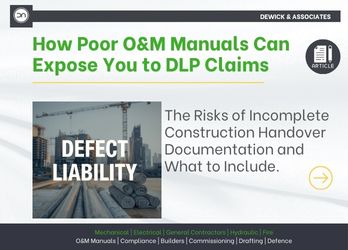
For builders and project managers, the Defects Liability Period (DLP) is a critical phase. During this time, contractors remain responsible for rectifying defects, often under tight deadlines and high pressure. However, incomplete or vague Operations & Maintenance (O&M) Manuals / Building Handover Manuals (BHM) can leave a business exposed, sometimes at significant cost.
Real-World Examples of DLP Risk
Elevator Maintenance and Safety Failures Resulting in Replacement Costs
In the 2006 Minato Ward elevator accident in Tokyo, poor maintenance and unclear procedural guidance for safety inspections, compounded by subcontracted maintenance teams working from inadequate manuals, contributed to a fatal malfunction when an elevator ascended with doors open. Investigators found that worn brake pads and loose bolts were present, and maintenance personnel did not know how to properly adjust key components during routine servicing. The result was not only a tragic loss of life but also replacement of affected elevator units costing around ¥168 million (approximately US$1.46 million) when the operators opted to replace rather than risk further failures. While this is a safety case, the root issue was incomplete operational and maintenance guidance for critical mechanical and electrical safety systems, and the retrofit/ replacement cost illustrates the financial impact. (source)
Incomplete Handovers for Mechanical/Electrical Documentation in an Infrastructure Project
In a hydro power project case study published by researchers, the operations and maintenance manuals for major mechanical and electrical systems (including spillway gates, instrumentation, and control logic) were inaccurate, incomplete or still missing even one year after substantial completion. Because control sequences, electrical interface instructions, and detailed mechanical operating limits were not available, the owner’s team struggled to retrieve correct procedures and had to rely on individual staff members’ knowledge. This led to project delays, repeated site visits, rework and additional contract admin and troubleshooting costs that were not originally budgeted, and in some instances required external specialists to recreate manuals after the fact. While this report did not provide a single consolidated dollar figure, stakeholders on similar projects commonly report hundreds of thousands to millions of dollars in unplanned rectification costs when O&M documentation is not delivered or is unusable. (source)
Conveyor belt downtime at a logistics plant due to poor cleaning and maintenance guidance
A logistics firm suffered a 100-hour conveyor system downtime because dust and debris accumulated in vents and moving parts. The existing mechanical O&M documentation lacked clear cleaning schedules, component access guidance, and preventive maintenance checks. That resulted in a significant production halt and a loss of around €70,000 from downtime, repair labour, and rushed parts orders. This is the kind of avoidable cost that better maintenance task descriptions and routines in the manual could have prevented. (source)
Rail depot HVAC system repairs delayed by outdated manuals
In rail maintenance sheds, technicians repeatedly struggled with HVAC system faults because the wiring diagrams and sequence descriptions in the maintenance manuals were out of date and poorly organised. Engineers spent extra time tracing circuit layouts and confirming system behaviour on the fly, often needing to book special access to roof gantries for repeated call-outs. Each unclear repair typically cost operators extra labour and extended downtime. While an exact dollar figure wasn’t reported, rail maintenance experts note that inefficiencies like these compound across fleets, increasing operating costs and reducing service availability. (source)
Inadequate Technical Documentation Led to a Major Warranty Claim
A Tier One builder in Victoria, prior to engaging Dewick & Associates, delivered a commercial project that included a large-scale glass roof system covered by a 25-year warranty. Within only a few years of completion, the builder was required to return to site following significant issues with the roof. The resulting investigation revealed that essential maintenance had not been carried out in line with the system’s requirements. When the builder referred to the handover and O&M documentation, there was insufficient guidance outlining the required maintenance procedures.
The maintenance tasks themselves were relatively straightforward. However, because they were not clearly documented at handover, there was no evidence that the responsibilities and requirements had been properly communicated to the building owner or facilities team. As a direct result of the inadequate documentation, the builder was unable to rely on the warranty provisions and was required to absorb the cost of rectification. The total cost of the repair was close to one million dollars.
This outcome could have been avoided with the inclusion of a small number of clear, well-defined maintenance instructions within the O&M manuals. This example highlights how poor technical documentation can expose builders and contractors to significant financial risk, particularly during warranty and defects liability periods, and reinforces the critical role that accurate, detailed O&M manuals play in protecting all project stakeholders. (source)
These examples show that poor documentation is not a minor oversight, it’s a risk multiplier. Without accurate, actionable instructions, even routine maintenance can trigger costly DLP claims.
Why High-Quality O&M Manuals Protect You
A complete and compliant O&M Manual is more than just a handover formality. It serves as a risk mitigation tool, providing:
- Clear maintenance schedules and procedures to prevent accidental damage.
- Safety protocols for on-site and ongoing operational tasks.
- Product and warranty information to ensure manufacturers’ requirements are met.
- Regulatory compliance guidance, aligning with standards such as CDM 2015, NCC, Australian / British / Canadian Standards,AIRAH DA19, NZ Building Act 2004, provincial Occupational Health and Safety (OHS) Acts, NFC and local building codes.
By investing in detailed, technically verified manuals, contractors can significantly reduce the likelihood of DLP disputes and protect their bottom line.
Key Elements Every O&M Manual Should Include
To avoid unnecessary liability, ensure your manuals cover:
- Asset and system descriptions with technical clarity
- Manufacturer-specified maintenance and operation instructions
- Safety and compliance guidelines
- Commissioning records and test results
- Contact information for ongoing service or troubleshooting
How Dewick & Associates Can Help
At Dewick & Associates, we combine engineering expertise with technical writing experience to create O&M Manuals that are comprehensive, accurate, and fit for purpose whilst meeting regulatory standards. Our team ensures:
- Technical verification by Chartered Engineers
- Compliance with Australian, UK, Canadian, and international standards
- Expertise in current regulatory requirements
- A tailored approach: documentation delivered in your required format and style
- Platform experience: we’re fluent in Aconex, Zutec, OmTrak / WebFM, and more
- Fast turnaround: we work to your deadlines, not ours
With the D&A approach, you’re not just handing over paperwork, we are providing you with the confidence and protection with the manuals we supply.
Protect your projects and reduce DLP exposure. Our team is on hand to discuss any questions or upcoming projects.
Supporting Articles
Find out more about why outsourcing your construction documentation can save you time and money.